

What’s a CCTV camera?
CCTV (Closed Circuit System) is a system that offers signals/footage used for the surveillance system that can protect people and property. It maintains security and privacy by not making the footage public. It is used for both small and wide area monitoring. The system has a camera, monitor, video recorder, wires and internet connection for closed-circuit monitoring.
Why is a CCTV camera required?
CCTV surveillance is required to prevent or reduce untoward incidents such as
Robbery– Theft and robbery cases can be controlled as there’s proof of everything. Whether used in commercial or residential setup, one can track when a criminal incident took place, who did it and what’s being robbed. Good quality camera can identify the criminal.
Employee monitoring: Other than security, one can monitor employees/workers at the factory or school. Also, one can monitor kids/nanny at home. In addition to the work efficiency CCTV camera helps in monitoring there’s no unsafe practice being followed at the workplace that breaches security.
Property protection: Camera acts like a virtual security guard when a person is not present at a site to monitor office property or employees’ vehicles. CCTV helps monitor the premises and safeguard property from any damage or catch the criminal in time.
Machine monitoring: Industries that require working with heavy machines, chemicals, etc. must have CCTV cameras for work safety of employees. One can observe overall activities at the place and warn or prevent employees in case of danger.
Its presence itself intimidates robbers of doing any crime.
How CCTV camera works?
CCTV system consists of a cameras, lenses, housing, video monitors, switchers and multiplexers, video recorders. Firstly, a need assessment is performed to finalize the location of the camera for proper security surveillance. It helps in defining the components such as angels, lighting, power distribution, etc. The camera captures the signals at the source in its digital chip. The signals are then converted into a stream of images. Depending on the location, the lens of the camera is decided such as wide angle, normal, zoom or telephoto. It focuses light onto the chip or image sensor. Inferior lens will never be able to deliver quality images.
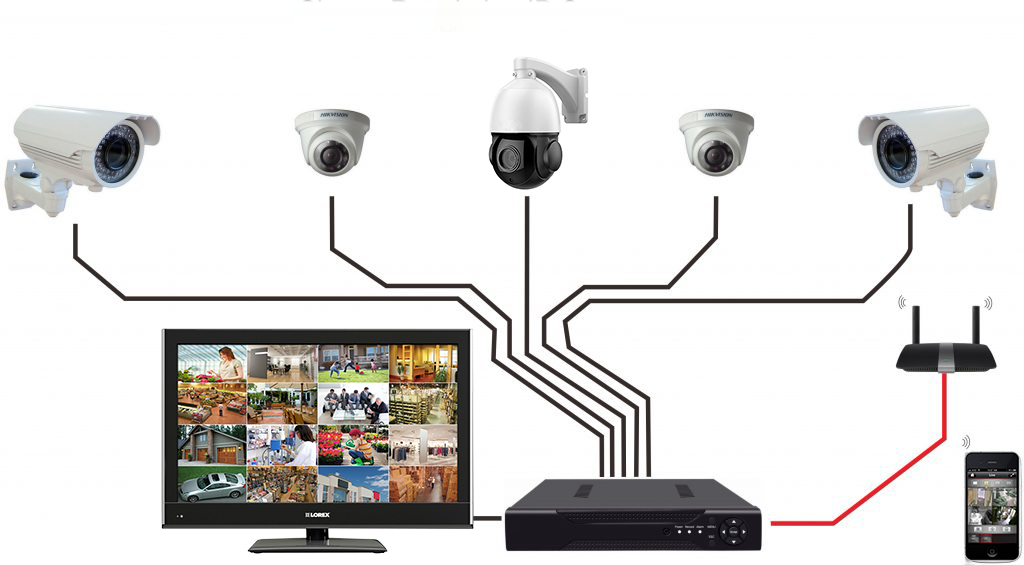

CCTV Camera installation is incomplete without proper housing. The mount and housing is selected basis the environmental conditions, architectural design of the property (shop, office, school, factory or home), etc. The different types of hosing include dome enclosures, impact- resistant, sealed, bullet-resistant, and tamper-resistant housing. Similarly, depending on the location, the mount is selected for the camera such as wall, pole, corner, pendant mount, etc.
The video captured by the camera is stored in a video recorder via cables. It could be a digital video recorder (DVR) or network video recorder (NVR). The storage capacity should be decided basis the number of cameras connected to the recorder. In case of NVR, the signals are gathered through a network instead of cable. This is for IP cameras.
The next element of the CCTV kit is the video monitor over which the video captured by the camera is viewed. In addition to the camera quality, the monitor quality also plays a crucial role. The video monitor could be LED, LCD, PC monitor, etc. Consider the size and pixel ration for clarity of the video.
Types of CCTV cameras
There are basically wired and wireless CCTV cameras
Bullet CCTV cameras: It is one of the most used CCTV camera for home, parks or any outdoor space. These are mounted on a wall or ceiling. Bullet cameras are waterproof and capture video in a fixed area. These lack features like zooming or panning.
Dome cameras: These have dome shape housing. This is visible but does not shout for attention. Dome cameras are quite popular in retail outlets, working area, staffrooms, etc. It is hard for people to know where the camera is directing. It is one of the best cameras to cover large areas/premises.
IP/wireless CCTV Cameras: It uses the Internet to transmit images. But this won’t affect the Internet speed. Since these don’t require too many cables, the wireless CCTV camera installation process becomes easier compared to the wired cameras.
HD cameras: In places that require higher security, HD cameras are the best. For example in banks, at cash counters or places that have confidential documents stored, need constant and good monitoring. HD cameras have zooming and similar features that will help reduce criminal activities or catch the criminal in case of any security breach.
Night vision CCTV cameras: These are best for traffic signals or parking areas as it provides great video capturing even at the night or in dark places. The infrared LEDs help to balance the lighting in the area.
Where to install?
For optimum utilization of CCTV camera and better surveillance, it is necessary to install CCTV camera at the right location. For clear identification of people or situation, consider these points while placing the camera
- The camera should focus the main object and situated quite closer to it
- If it is for identifying activity in a larger space, the camera must have wider angles and placed at a higher position.
Best locations for CCTV setup listed below
- Maine gates: CCTV cameras must be installed at the main entry and exit gates. At these places, no one can rush through. Whether making an entry in a register or opening door locks, time is consumed that offers camera an opportunity to take a clear picture of the visitor. The camera should not be too high to capture an individual’s face.
- Cash counter/Reception: Reception, cash counter, or waiting area is another crucial point for proper identification of visitors. This area should have more than one camera for individual identification as well as activity observation.
- Parking: For monitoring of criminal incidences happing in parking lots, along with proper flood lights, there should be cameras installed everywhere. These will keep the vehicles safe from robbery or other malfunctions.
- Hallways: Aisle and hallways are places that sound safe to some of the workers/employees/students/outsiders to plan criminal activities. But for the others, these places seem abundant and unsafe. With CCTV cameras in place, they can have a sense of security.
- Working areas: Classrooms, staffrooms, and working areas of an office or factory are other important places where a CCTV must be installed for security. Additionally, you can monitor activities of your employees and class atmosphere, like if the students and teachers are going well together.
- Transportation sector: CCTV cameras are of great use in transportation services, especially for underground vehicles. In addition to monitoring criminal activities, the department can track passengers’ movements. Similar is the case at traffic signals.
Maintenance of CCTV Camera
For proper functioning of the CCTV camera, it is necessary to maintain it, else it might breakdown suddenly at the time of need and you would have nothings to do but regret. A camera should be checked once every month. There could even be location change of camera required as offices get interiors changed frequently now-a-days. CCTV camera maintenance includes check the wiring, camera and recording device. Here’s a checklist for the same
- Camera should have a waterproof housing. Open the enclosure to remove moisture or dust in present around the camera. Change camera placement or housing if it is not protected from dirt and water.
- Check the wires and connector for any corrosion. Replace the defected piece immediately.
- Clean outdoor and indoor camera lens for footage clarity. Don’t let dust or moisture accumulate over it and remember to do it very safely.
- Keep the camera’s view clear by regularly trimming trees or bushes hindering the focus or angles.
- Delete old and unnecessary videos from the hard drive for new recordings.
- Check the video recordings periodically to see if the surveillance system is working properly and there is no defect with the wiring.
- See if the recorder is recording and displaying video with correct brightness and contrast
- Monitor the system for correct time and date, and make changes if required.
- Regularly check the functioning and focus of the camera