

Translate:

A quick look at different types of resistors
We have all learned in school about conductors and insulators. A conductor is something that permits electricity to flow freely through it, whereas the insulator does not easily allow current to pass through it.
These characteristics are due to resistance: conductors have a low resistance to the flow of electric current, whereas insulators have a high resistance to the passage of electric current.
There are many different types of resistors, which can be split into two groups: fixed and adjustable resistors (variable resistor).
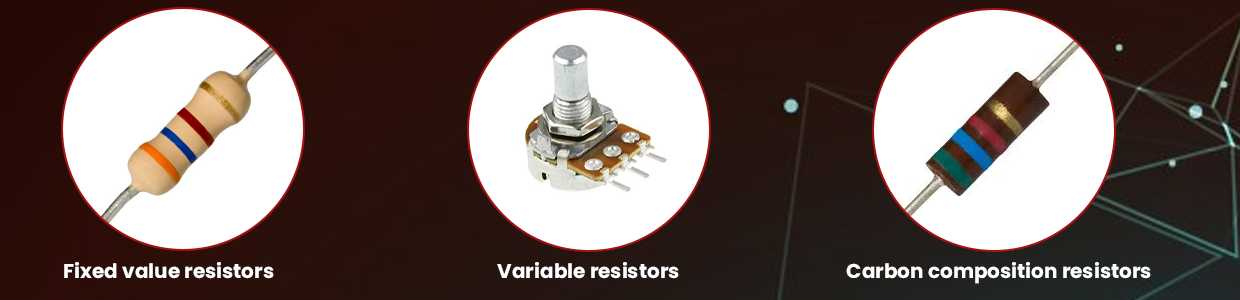
Fixed value resistors:
These resistors provide a constant level of resistance in a circuit. Because it is set at a given value, a fixed resistor cannot be modified.
Variable resistors:
These resistors have a variable resistance value. Variable resistors allow us to vary the resistance value.
Further classification of fixed and variable resistors:
Based on their construction, fixed value resistors are further classified as
- Carbon composition resistors
- Carbon film resistors
- Metal oxide film resistors, and
- Wire-wound resistors
Variable resistors are classified based on how the value of the resistance is modified. This value is determined by the operator or other natural sources. They are categorised as:
- Potentiometer
- Light dependent resistor, and
- Thermistors
Carbon composition resistors:
These resistors have been around for nearly a century, although they are rarely used nowadays. In comparison to our standard resistors, they are quite huge. Carbon composition resistors are manufactured by combining carbon granules with a binding agent and then converting the mixture into a tiny rod. The ability to endure a high amount of energy pulses is the most significant advantage of these resistors.
They have a number of drawbacks, including large size, noise, a high negative temperature coefficient, and instability. Because of these drawbacks, this type of resistor is no longer utilised or is only used infrequently. They are suitable for usage under RF loads.
Carbon film resistors:
These resistors feature a carbon layer on the ceramic former and are insulated with a substance such as epoxy (for protection). Today, superior resistor technologies are available at lower costs, hence this type of resistor is no longer employed. Carbon film resistors are made by breaking hydrocarbons on a ceramic former, which results in the formation of a carbon film. After that, connections are made, and the resistance value is adjusted with a helix cut.
The smooth curve on the surface is known as the helix cut, and it is this that makes these resistors inductive and suitable for use in RF applications. A trimming line represents the helix curve. To close the carbon film, an electrode cap is linked to the lead wire.
Metal oxide film resistors:
This resistor is still commonly used today. They outperform carbon film resistors by a wide margin. Metal oxides (metal films) such as tin oxide are deposited on the ceramic carrier in this process. The resistance is then modified by clipping the line. The resistance is affected by the thickness of the deposition and then by the helix curve. After that, an epoxy protection layer is applied to the outside covering (insulation coating).
Metal film resistors have a lower noise level and can be manufactured to a considerably tighter accuracy, making them significantly superior to carbon film resistors. This sort of resistor is now found in practically every application. These thin film resistors can endure high temperatures because they have an insulating ceramic rod that prevents heat from passing through them.
Wire wound resistors:
Here, the metalcore (wire) is wound on a ceramic former to make wire wrapped resistors. This provides higher resistance than the standard. They are coated with vitreous or silicon enamel after wrapping wire. The electrode cap is used to tighten the entire material. For high-power applications, this type of resistor is employed.
Potentiometer (Pot):
They have three terminals and a rotating shaft that adjusts the resistance value when turned. The resistive track on the potentiometer is made of resistant material. The amount of resistance changes when the wiper is rotated, and this is mirrored in the potentiometer's second terminal. Fan regulators, power supply, and other applications employ this type of resistor.
Variable potentiometers come in a range of mechanical types that make it simple to alter a voltage, current, or the biasing and gain control of a circuit to achieve a zero situation. Slider potentiometers, Presets, trimmers, and rheostats are a few of them.
Slider potentiometers are potentiometers with a slider that changes the resistance value with a linear force. Presets, sometimes known as trimmers, are small potentiometers. They're used in a circuit where we merely have to plug them in and forget about them. A rheostat is a variable resistor that regulates current flow. They can change the resistance in a circuit without breaking it. The construction is identical to that of potentiometers, except that there are only two terminals.
Light dependent resistor (LDR):
As the name suggests, the resistance of an LDR changes in response to the amount of light falling on it. Light-dependent resistors contain a photosensitive track constructed of cadmium and silicon that is light-sensitive. It has a resistance that varies depending on the wavelength of light that strikes the LDR.
LDRs, also called photoresistors, are utilised in light-sensitive applications such as smart street lighting, cameras, and other similar devices.
Thermistors:
These are thermally sensitive resistors, which means their resistance changes as the temperature rises. Thermistors are divided into two categories:
NTC (Negative Temperature Coefficient) thermistor:
The resistance of an NTC thermistor lowers as the temperature rises. NTC thermistors have a far higher sensitivity than silicon temperature sensors and RTDs. The temperature of the NTC thermistor can be changed in two ways. First by altering the temperature of the surrounding, and secondly by increasing the current in the thermistor.
PTC (Positive Temperature Coefficient) thermistor:
The resistance PTC increases as the temperature rises. The term PTC refers to a thermistor. Symbol of PTC thermistor has +t because it has a positive temperature coefficient. PTC thermistors are frequently employed as self-regulatory heaters. When a large amount of current is put through it, more heat is produced, and the thermistor's resistance drastically increases. As a result, they are frequently seen in temperature-dependent time delay circuits.
Conclusion:
Resistors may appear simple, but their uses are limitless. For example, they are an important component in any circuit, whether it is a basic op-amp gain circuit, or a sophisticated switching circuit. In this post, we have covered all of the basic fundamentals of resistors types, which should help you feel more at ease when analysing the function of a resistor in a circuit. Get the best offers on resistors by going to Moglix today.


 +91 9999049135

