

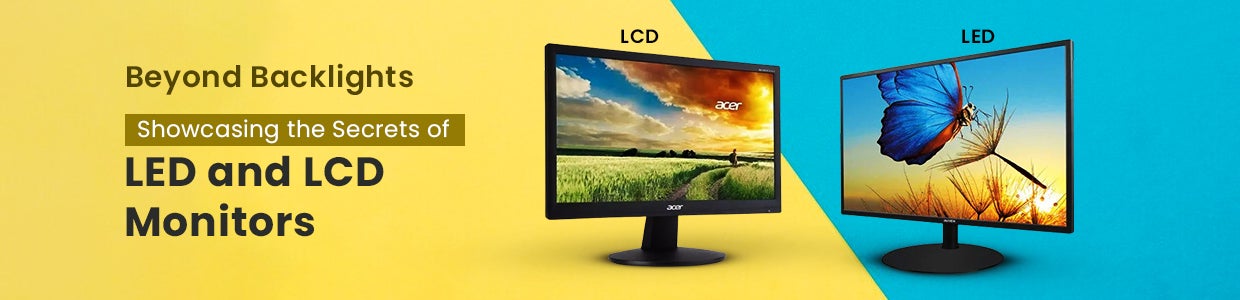
Beyond Backlights: Showcasing the Secrets of LED and LCD Monitors
In the growing world of technology, India's manufacturing sector caters to a large market for monitors. With an incredible revenue of ?153.4 billion generated in the PC monitors and projectors sector alone for 2024 and an estimated growth rate of 2.8% CAGR, it is clear that Indians are demanding ever-better visuals for their monitors. Smart Indian consumers are always seeking top-notch displays, leading to the question: Beyond Backlights: Showcasing the Secrets of LED and LCD Monitors.
Let's start exploring the fascinating world of LED and LCD monitors, revealing the secrets behind those backlights and pixels. We will delve into the inner workings of LED and LCD monitors, conduct a comparative analysis of these technologies, and equip you with the knowledge to make an informed decision when choosing your perfect display.
Decoding Display Tech: A Deep Understanding of LED and LCD Monitors
Looking at a screen, all? India?s monitor market is growing rapidly, but are you choosing the right one for you or not? This article guides you to clarify your jargon, clarify the difference between LED and LCD monitors, and help you to find the best monitors.
(A) Understanding the basics of LCD (Liquid Crystal)
How liquid crystal works ? LCD panels provide backlight behind the screen, and basically, they emit white light. That light passes through a polarizing filter, allowing light waves to vibrate in only one specific direction, and after that, light encounters a layer of liquid crystals. These crystals can twist the light as it passes through. And electrode activation creates an image on the screen.
Understand the role of backlights - Backlights play a crucial role in an LCD monitor's screen because liquid crystals do not emit light on their own. The backlights radiate crystals from behind, making the image visible on display. Without a backlight, we are not able to see on LCD screens.
Major advantages and limitations of LCD monitors.
Advantages | Limitations |
Consumes less power and generates less heat as compared to CRT (cathode ray tube) | Require backlights for their functions, and sometimes light leaks around the edges of the screen, affecting the viewing experience in the dark |
Have thin screens that are lightweight | Not able to handle fast-paced scenes, online games, and start blurring the screen |
LCD produces sharp, bright images with high resolutions, contrast, and rich colors. | Consumes more power and generate more heats as compared to OLED (organic light-emitting diode) |
Affordable | Limited viewing angles as compared to OLED |
(B) Understanding the basics of LED (light-emitting diode)
The working process of LED- The working process of LED monitors involves sending signals through transistors connected to each of the thousands of light arrays. As electrons pass through these transistors, they are converted into light, creating a picture on the screen.
Advantages of LED Monitors: LED monitors aremore energy efficient because they consume less power and provide longer battery life. Furthermore, LED monitors have superior brightness levels, enhance visibility in different light conditions, and make them suitable for indoor and outdoor use. LED also gives better color accuracy and a wider color range, leading to more vibrant and true-to-life images, LED have a longer lifecycle and are more durable as compared to traditional ones, ensuring a longer-lasting display with consistent performance over time.
Additional Notes:-
All modern LCD monitors use LED backlights, so there isn?t a separate category for ?LED monitors?.
The core image creation technology in both is based on liquid crystal.
The LED backlight offers an improvement over the older backlight option of CCFL (cold cathode fluorescent lamp) in efficiency and potentially higher brightness.
Exploring the Comparative Analysis: LED and LCD monitors
Features | LCD monitors | LED monitors |
Technology used | Liquid crystal display | Light-emitting diode |
Light source | Requires an external backlight (typically CCFL or LED) | Provides the light source for LCD panel |
Image creation | Liquid crystals manipulate and control light. | Doesn?t directly create the image. |
Advantages | Affordable, thin, lightweight design, less screen burn-in risk | Improved energy efficiency, potentially higher brightness, environmentally friendly |
Limitations | Not as high contrast ratio, Backlight Bleeding, Slower Response Times | Backlight Bleeding |
Conclusions:
We all know that LCD and LED monitors both use liquid Crystal to display images on screen. Although, LED monitors have a clear advantage due to their use of backlights.
Suggestions to buy LCD monitors if: You have a limited budget and desire for a thin and lightweight display. You buy these monitors for basic use not for gaming or online streaming because it has less response time and contrast ratio. As a result, performing tough tasks on these monitors will be difficult as they will start to show blurred screens after some time.
Suggestions to buy LED monitors if: You have no issue regarding budgets and you have a desire for a high picture quality display, including higher contrast ratio, better brightness, and wider viewing angles. LED consume less power and they have a longer life cycle.
Top Sellers











New Arrivals

Lenovo L27i-4A 27 inch 1920x1080p Light Metallic Grey FHD IPS Monitor, 67BEKAC1IN
Lenovo L24-4e 24 inch 1920x1080p Raven Black FHD IPS Ultra Slim Monitor, 68C2KAC1IN
Lenovo L22i-40 22 inch 1920x1080p Cloud Grey FHD IPS Monitor, 67AEKACBIN
Lenovo D22-39 21.5 inch 1920x1080p Black FHD IPS Monitor, 67D9KACMWW
Lenovo L24-4C 24 inch 1920x1080p Cloud Grey FHD IPS Ultra Slim Monitor, 67DDKAC6IN
Lenovo ThinkVision 27 inch 3840x2160p UHD IPS Black LED Monitor, T27p-30
Acer 23.8 inch 1920x1080p FHD IPS Black Touch Screen Monitor, UT242Y
Lenovo 27 inch 2560x1440p WQHD IPS Raven Black Backlit LED Monitor, P27q-30
Acer 31.5 inch 1920x1080p FHD VA Black Curved Gaming Monitor, ED320Q W0



 +91 9999049135

