
Silicon Composite Battery Technology: Just an Experiment or the Future
For several years, the batteries of flagship smartphone models have evolved rarely. Samsung Galaxy S20 Ultra launched with a 5,000 mAh battery, and four years later, the Samsung Galaxy S24 Ultra was released with the same 5,000 mAh battery capacity. Most commonly, they extended battery life in other ways: energy-efficient chips, adaptive displays, and more. Because the battery hardware itself didn?t change much.
However, now technology is advancing. Things have started to shift, and average smartphone battery capacity is now being moved from 5,000 to 7000 or even 8000 mAh+, offering higher smartphone usage hours. But it becomes more difficult to balance compactness with higher battery capacity. By January 2026, the average smartphone battery capacity had climbed globally, without getting noticeably thicker or heavier. The reason: the introduction of silicon composite (silicon-carbon or Si-C) anode technology.
Most probably, you have already seen this term in the headline on the phone reviews. It?s not just a new fancy term for a new feature. This is genuinely a great advancement in battery technology, but it is yet to be seen whether it is sustainable growth or a short-lived experiment before something better comes along. Here?s what this technology actually is, which brands have offered it till now, and what the usage says.
What Is a Silicon Composite Battery?
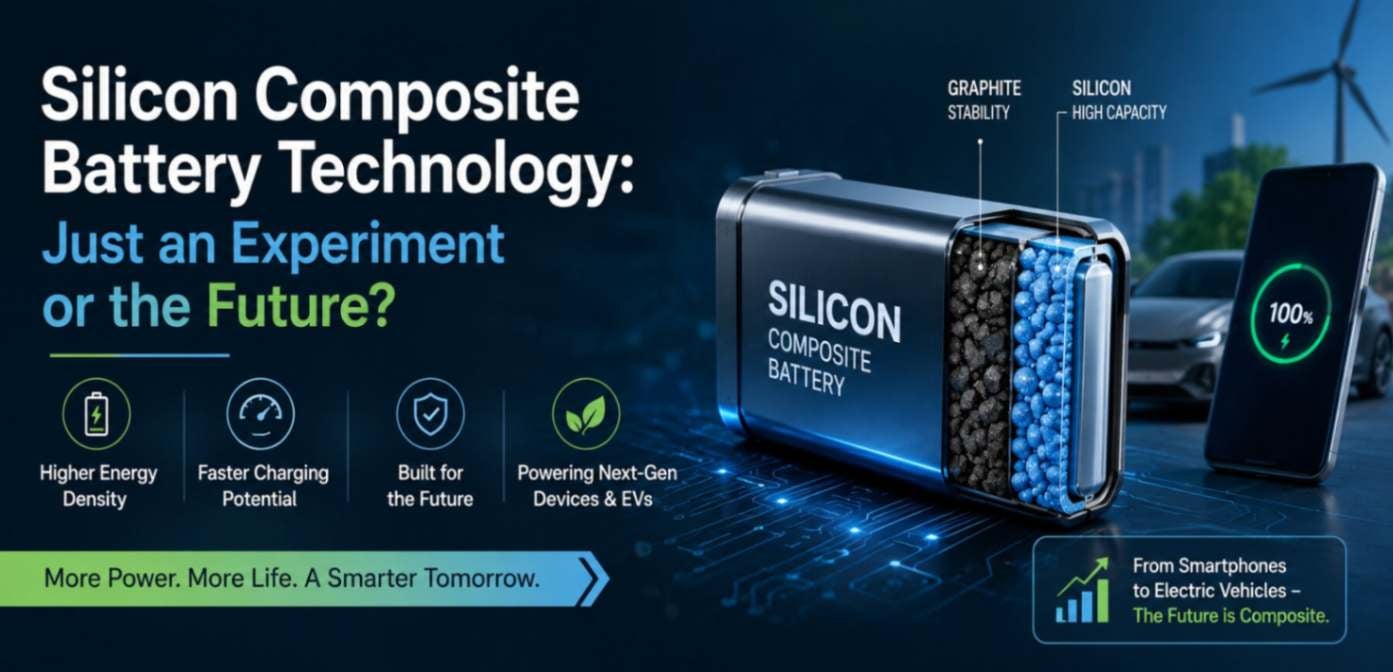
A silicon composite battery is not a completely new hardware or battery chemistry. It is an upgraded form of lithium-ion battery, in which the anode and the electrode that store lithium ions when the battery is charging have been replaced. Where traditional lithium-ion batteries use graphite as the anode, the silicon carbon batteries replace it with a silicon carbon blend. It provides a robust upgrade in performance, packaging more power that drains slowly and can hold more without getting bigger or heavier.
How Silicon Beats Graphite in Smartphone Batteries?
Why Silicon Beats Graphite | Key Point |
Higher Capacity | 4,200 mAh/g vs 372 mAh/g |
10�+ More Storage | Much higher theoretical capacity |
Higher Energy Density | Enables more energy in less space |
Used with Graphite | Pure silicon is rarely used |
Swelling Issue | Expands significantly during charging |
How Is the Swelling Problem Fixed by Silicon Carbon?
Pure silicon: Expands up to 300% during charging.
Repeated swelling: Causes cracks and reduces battery life.
Key challenge: Swelling delayed silicon's commercial adoption.
Carbon matrix: Contains silicon and controls expansion.
Reduced swelling: Drops to around 10?20%.
Still a challenge: Expansion remains higher than graphite.
5-10% silicon: Improves stability.
15-30% silicon: Increases energy density but needs better swelling control.
Who Started The Silicon Carbon Battery Trend: Chinese Smartphone Brands
Silicon-Carbon batteries became popular first, when Chinese smartphone brands began testing to improve the battery performance of their models. Here are the points to understand how silicon carbon batteries come into play:
Silicon carbon batteries were first adopted by the Chinese brands.
The technology moved from the testing phase to mainstream devices in just a few years.
By 2026, Brands like OnePlus, Xiaomi, Honor, vivo, OPPO, and Samsung, used in their flagship models.
This shows that silicon-carbon batteries had moved beyond testing and were becoming a major smartphone battery technology.
Samsung's Late Entry into Silicon Carbon Battery Technology
Samsung entered late: Chinese brands introduced silicon-carbon batteries much earlier.
Safety first: Samsung focused on safety, durability, and battery stability before adoption.
Galaxy S26: Launched without silicon-carbon batteries.
Later adoption: Samsung introduced the technology in its 2026 foldable phones.
Why the delay: Its cautious approach is often linked to the company's past battery safety issues.
The trade-off: Samsung prioritised reliability, while competitors moved faster to higher battery capacity.
Experiment or the Future?
According to the evidence, the answer lies somewhere in between. Silicon composite batteries have already surpassed the experimental stage and are showing measurable results. Now, they are being shipped in millions of devices, from smartphones to EVs. That?s not what a short-lived trend looks like.
However, the technology has not yet been fully developed to provide long-term durability and cost at scale. Currently, the technology has not yet answered every question, but it looks like a genuine transition point in battery technology.
Looking for the top-rated Batteries?
Browse our complete collection and find the best product today.



Top Sellers