

Translate:

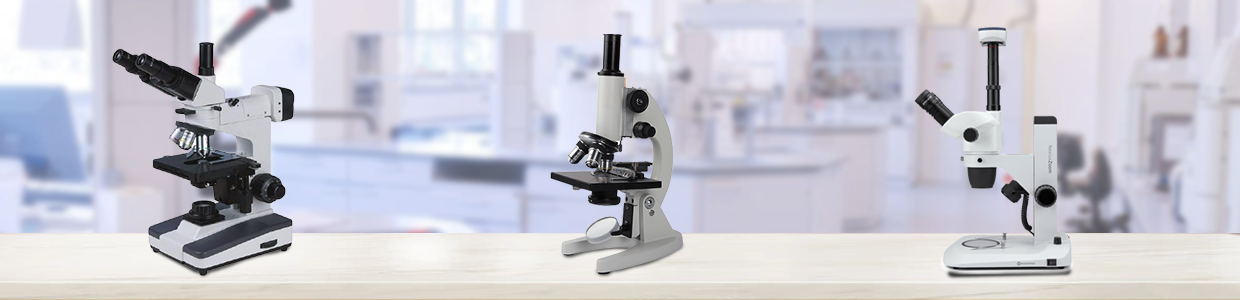
Quick guide to select the best microscope for critical lab applications
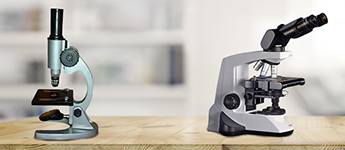
A microscope is an instrument used in laboratories or otherwise, used to see things with naked eye by enlarging them. There are numerous experiments and research that might require a microscope to see objects like small microbes. Microscopes, ever since their inception, have played an important role for humans in undertaking some of the biggest observations, leading to some huge discoveries and inventions that have changed the world forever.
So, if you are a doctor, a scientist, a teacher or a student getting ready to take on the world, chances are you might need a microscope for your study or the organization you work or study in.
That being said, if you are indeed looking to buy one, you are probably confused about what all specifications to look for, and you would not want to miss any. So, we have compiled all the necessary information that you should have to buy the right kind of microscope.
Types of Microscopes:
Stereo Microscopes-
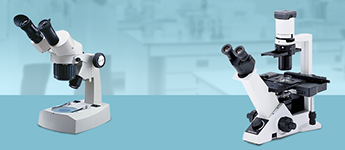
A stereo microscope is used to get a 3D image of an object. These are used when the samples can be held in your hand. The magnification provided by a stereo microscope is between 10x-40x. Stereo microscopes use transmitted and reflected illumination. These can be used to view samples that do not allow the passing of light through them. This kind of microscope is used in schools, coin collecting, quality control etc.
Compound Microscopes-
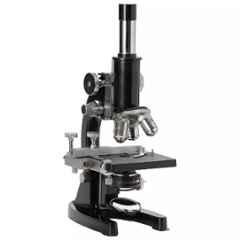
In compound microscopes, often called biological microscopes, the samples to be observed are flattened on a microscope slide, by using a cover slip. These microscopes are mostly used to observe biological samples like blood cells, cheek cells, tissues, parasites, algae, etc. These microscopes have a magnification of 40x, 100x, 400x, and even 1000x. These are extremely powerful. But, the higher the magnification, generally, the lower is the resolution. These are best suited for laboratories, water plants, schools, and pathology.
Metallurgical Microscopes-
Metallurgical microscopes have a very high power. These are specially used to view samples that are opaque and do not allow any light to pass through them. These help in witnessing cracks in metals of the micron level. These have a magnification of 50x, 100x, 200x, and 500x. Their usage can be found in metallurgical industries, aerospace industries, and automobile industries.
Inverted Microscopes-
Metallurgical microscopes or biological microscopes can be availed in a variant of inverted microscopes. Using a biological inverted microscope, samples can be viewed in a petri dish. These are used for live cell imaging, in vitro fertilization, cell biology, neurobiology, etc. These are used to study cells and tissues. These have a magnification of 40x, 100x, 200x, and 400x. Whereas, using a metallurgical inverted microscope can help view fractures in metals.
Polarizing Microscopes-
Unlike other microscopes, which use transmitted or reflected light for illumination, this microscope uses polarized light for illumination. Only a few light waves can pass through the polarizer. The amount of light and direction of light for illumination is defined by the analyzer. Polarizing microscopes are used for viewing birefringent materials. These are used by geologists, chemists, petrologists and the pharmaceutical industries.
Factors to consider before buying a microscope:
Now that all the types of microscopes are clear, let us also look at the factors that will determine which type you need and help you make the best decision.
Light Source-
As evident from the types, there are different light sources that a microscope uses, like transmitted, reflected, or polarized. There are certain samples that allow light to pass through them, for such samples reflected light can be used. But if the specimen blocks light, an external source will be required. So, be firm on what kind of specimens you will be examining to make a decision.
Specimen Stage-
To observe your sample, you need a place for it to be kept. Depending upon the size of the object under observation, this place will also change in size. In some microscopes, this sample will be mounted directly under the objective, and will be movable, i.e., can be moved higher or lower or sideways. This will help the observer to adjust the stage to get a better view. Clips may also be provided to hold the sample in place. Be clear about the size of the stage you require.
Objective Lenses and Nosepiece-
Most microscopes will come with many lenses or objectives with different magnifications. These lenses are fixed upon a nosepiece. This nosepiece will aid the viewer in shifting from one power to the other. There must be some kind of mechanism to block the power from shifting, once you have reached the right setting. So, make sure both of these things are working well.
Eyepiece-
You look at your sample through what is called as an eyepiece. This eyepiece may be permanently attached to the microscope or be removable. This will also contain the magnification. Compound microscopes use the combined magnification of the eyepiece and the objective to view objects. So, you need to decide if you want an eyepiece with magnification, and that too, fixed or removable.
Aperture Diaphragm-
The hole where the specimen is kept in the centre of the stage has a system that controls the amount of light falling upon and around it; this is called the aperture diaphragm. Typically, a diaphragm is a disc with different-sized holes. If you are willing to spend more, you might go for something called an iris diaphragm, which, just like an Iris provides continuous variable diameters and provides a smoother control of light.
Quality of the body-
Other than the major specifications, it is also important to know the material of the framework of microscope. One must opt for a good quality product, not just for the outer body, but the quality of the lenses, i.e., the optical quality matters too. If the microscope is going to be used by multiple people daily and you want it to last long, then this aspect needs to be thoroughly checked.
Microscope Price-
The last and most important of all is the cost of a microscope. Once you have stitched together all these aspects and know which type you want, you must draft a budget to tell you which bracket to look for. There are good-quality microscopes that are available at highly reasonable prices, and there might be basic microscopes that will quote an unreasonable price. As a consumer, you need to research well in that aspect and make the right investment.
Conclusion:
This was all that you had to grasp about microscopes before purchasing one. Microscopes come under objects that last for long periods, and hence buying one which is capable of lasting long is important. While you choose your brand, you must also look out for the services that the company will be willing to provide in case something goes wrong, the microscope needs servicing or the parts are to be replaced. Think about all these aspects and go for it...!
Microscope: FAQs
Q. Which microscope is more powerful?
A. Out of all the microscopes mentioned, compound microscopes are more powerful. A compound microscope uses the combination of magnification present in the eyepiece and the objective. The magnification of the eyepiece ranges from 10x-15x, whereas the objective may have a range of 4x to 100x, which, when combined, becomes manifold.
Q. What kind of microscope should I buy?
A. You must have a thorough knowledge of all the types of microscopes that are available, this alone will give you a rough idea of which one you need. But to get a clearer picture, jot down all the specifications for the factors mentioned above that you must consider. Align all these answers and you will get the right fit!
Q. Why are microscopes so expensive?
A. Microscopes combine many small elements, which, albeit small, significantly affect the overall output. If you want good quality, these elements alone cost a lot to manufacture. This cost, combined with the other factors of production, results in a high price.
Q. What is the best microscope for home use?
A. That depends upon what you are willing to examine at home. But for a basic study, which requires less power and less complicated specimens, a stereo microscope would work fine. If you want to examine biological specimens at home, then an inverted microscope would do the job.
Top Sellers
New Arrivals

Optike 60X Shop Floor Microscope with 0.02mm Scale Least Count, KHM7527
Optike 40X Shop Floor Microscope with 0.05mm Scale Least Count, KHM7526
Optike 20X Shop Floor Microscope with 0.1mm Scale Least Count, KHM7525
Optike 100X Shop Floor Microscope with 0.01mm Scale Least Count, KHM7528


 +91 9999049135

