

Translate:

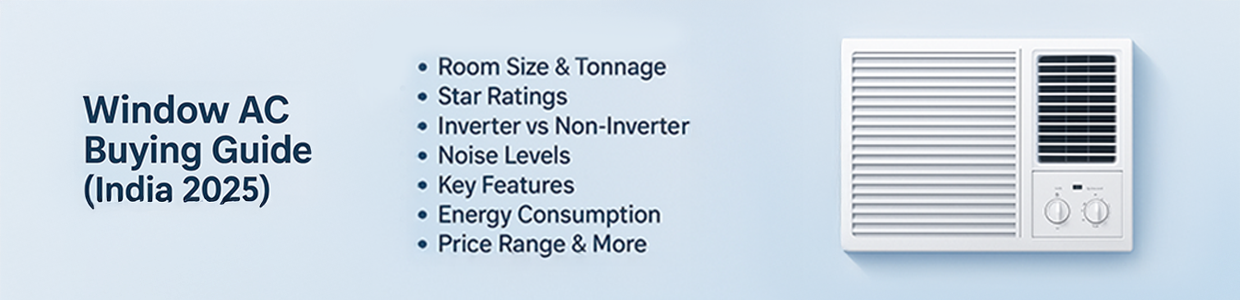
Window Air Conditioners in India (2025): The Complete Buying Guide
Window air conditioners (ACs) continue to be a popular choice in India, especially in urban areas like Delhi, due to their affordability, ease of installation, and suitability for compact spaces. With advancements in technology, modern window ACs now offer features such as inverter technology, smart connectivity, and energy-saving modes.
What Is a Window AC and How Does It Work?
A window AC is a self-contained cooling unit designed to fit into a window or a specially made wall opening. It houses all components - compressor, condenser, expansion valve, and evaporator - within a single box. The unit draws in warm air from the room, cools it using refrigerant, and expels the heat outside, thereby lowering the room temperature.
What Does Star Rating Mean?
In India, the Bureau of Energy Efficiency (BEE) assigns star ratings to ACs, ranging from 1 to 5 stars. A higher star rating indicates better energy efficiency, leading to lower electricity consumption and reduced bills. For instance, a 5-star window AC is more energy-efficient than a 3-star model.
Are Inverter Window ACs Available?
Yes, inverter technology is now available in window ACs. Brands like LG and Carrier offer inverter window ACs that adjust compressor speed based on cooling demand, resulting in energy savings and consistent temperature maintenance.
Window AC vs. Split AC: Which Is Better?
Feature | Window AC | Split AC |
Cost | Generally more affordable | Higher initial investment |
Installation | Easier and quicker | Requires professional installation |
Energy Efficiency | Less efficient compared to split ACs | More energy-efficient, especially inverter models |
Noise Level | Louder due to all components in one unit | Quieter operation as the compressor is outside |
Aesthetics | Visible from both inside and outside | Sleeker design blends with the interior |
Window ACs are ideal for smaller rooms and budget-conscious buyers, while split ACs are suitable for larger spaces and offer better energy efficiency.
Why Are Window ACs Cheaper?
Window ACs are typically less expensive due to:
Single Unit Design: All components are housed in one unit, which reduces manufacturing costs.
Simpler Installation: Requires less labor and no additional piping or drilling.
Lower Maintenance: Easier to service with readily available parts.
These factors contribute to the overall affordability of window ACs.
Most Popular Window AC Ranges in India (2025)
In 2025, the most sought-after window ACs in India fall within the Rs.30,000 to Rs.40,000 price range, particularly the 1.5-ton 3-Star models. Brands like LG, Voltas, and Lloyd are leading the market with energy-efficient and feature-rich offerings.
Calculating Annual Electricity Consumption and Costs
To estimate your AC's annual electricity usage:
1.5 Ton Window AC: Consumes approximately 1.5 kWh per hour.
Daily Usage: If used for 8 hours daily, that's 12 kWh/day.
Annual Consumption: 12 kWh/day * 365 days = 4,380 kWh/year.
Electricity Cost: At Rs.8 per kWh, annual cost = Rs.35,040.
Note: Actual consumption may vary based on usage patterns and AC efficiency.
Window AC Buying Guide (India 2025)
Buying a window AC involves more than just picking the right tonnage. Here are all the key aspects to consider before making your decision:
1. Know Your Room Size
Choose the correct tonnage based on the room size and environmental factors:
Room Size (sq. ft.) | Recommended AC Capacity |
Up to 100 | 1 Ton |
100 - 150 | 1.5 Ton |
150 - 180 | 1.6 Ton |
180 - 250 | 2 Ton |
250 - 400 | 2.5 - 3 Ton |
Tip: If your room has large windows, direct sunlight, or is on the top floor, consider going a step higher in tonnage.
2. Check Energy Efficiency (Star Ratings)
BEE Star Ratings (1-5 stars) reflect the energy-saving potential.
5-Star Inverter AC = highest efficiency + lowest electricity bill.
Look for ISEER rating (Indian Seasonal Energy Efficiency Ratio). Higher is better.
Pro Tip: Over 2-3 years, the savings from a 5-star model can make up for the higher initial cost.
3. Inverter vs Non-Inverter Window AC
Type | Benefits |
Inverter | Energy-saving, quiet, and better cooling |
Non-Inverter | Lower cost, ideal for short-term or occasional use |
Inverter Window ACs now available from LG, Voltas, Blue Star, Carrier, etc.
4. Must-Have Features in 2025
Sleep Mode: Automatically adjusts temperature at night.
Smart Connectivity: Wi-Fi-enabled for mobile app control.
Dehumidifier Mode: Great for humid areas like Mumbai or Kolkata.
Air Filters: Anti-bacterial, PM2.5, and dust filters improve air quality.
Self-Diagnosis: Shows error codes for faster servicing.
Auto-Restart: Resumes operation after the power cut with the last settings.
Eco/Power Saver Mode: Optimizes energy usage.
5. Noise Levels
Check decibel (dB) levels in the product specs.
Look for models below 50 dB for bedrooms.
Window ACs are generally louder than splits, but newer inverter models are quieter.
6. Installation & Service Support
Make sure the brand offers free or low-cost installation.
Confirm service center availability in your city.
Check for warranty coverage:
Compressor: 5-10 years
Overall unit: 1-2 years
7. Price Range & Best Value Segments
Most selling models in 2025 (India):
Segment | Price Range | Popular For |
Budget 1 Ton AC | Rs.25,000 - Rs.30,000 | Small rooms, rental homes |
1.5 Ton 3-Star AC | Rs.30,000 - Rs.38,000 | Best value for standard bedrooms |
Inverter 1.5 Ton 5-Star | Rs.40,000 - Rs.48,000 | Energy-efficient long-term use |
Premium 2 Ton ACs | Rs.48,000 - Rs.60,000+ | Living rooms or large master rooms |
Best sellers: Voltas 1.5 Ton 3-Star, LG 1.5 Ton Inverter, Lloyd 1.5 Ton with PM2.5 filter.
8. Estimate Electricity Consumption
Here's how to calculate your potential energy cost:
Formula:
Units per year = Power Rating (kW) * Hours per day * Days per year
Example:
A 1.5 Ton, 3-Star AC consumes ~1.5 kW/hr.
Daily use = 8 hrs
Days = 180 (summer use only)
Annual Units = 1.5 * 8 * 180 = 2,160 units
At Rs.8/unit = Rs.17,280/year
Inverter ACs can save up to 25-40% on this amount!
9. Where to Buy
Online: You can explore moglix.com to buy the best window AC with a great deal
Offline: Vijay Sales, local electronics stores (often offer installation discounts)
Check for:
Cashback offers
EMI options
Free installation & stabilizer deals
Extended warranty plans
10. Red Flags to Avoid
Don't go for:
No-brand models with no service support
Underpowered ACs for large rooms (inefficient cooling)
Outdated models from previous years
Want help calculating exact tonnage for your room or comparing models? Just let me know your room size, location, and budget, and I'll give you tailored options!




 +91 9999049135

