
Translate:

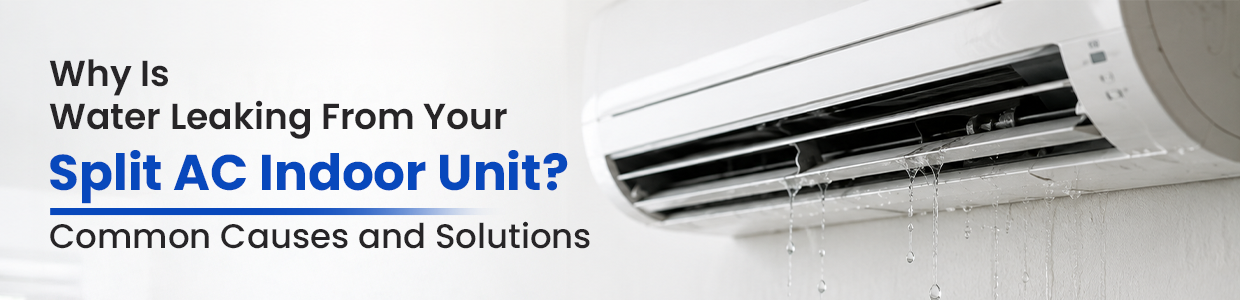
Why Is Water Leaking From Your Split AC Indoor Unit? Common Causes and Solutions
Are you frustrated because your split AC indoor unit is facing leaking issues? Well, you are not alone: so many people across the world experience the same AC issue that could happen due to several reasons. AC water leaking issues in the indoor unit could be common but depend on the density of water leakage. Especially, water dripping from the indoor unit of a split AC is not normal. These issues could happen due to a clogged condensate drain pipe, a dirty or clogged air filter, a frozen evaporator coil and many more.
If you avoid these issues, it could lead to damage to walls, ceilings, furniture, and even reduce your air conditioner's cooling performance. However, water leaks from AC can be resolved easily in many cases, especially if the problem is easy to identify and fix. In this guide, we have covered all the causes that lead to AC water leaks from the split AC indoor unit and their solutions. Some of the solutions can be simply performed at home. So without any minute delay, lets get into it!
Common Causes and Solutions: Water Leaking From Split AC Indoor Unit
A split air conditioner works by removing heat and humidity from the indoor air. This process removes moisture from the air to condense on the evaporator coil and turns into water. This water normally flows into a drain pan and exits through the condensate drain pipe.
Here are the common reasons and solutions-
1. Clogged Condensate Drain Pipe
One of the most common reasons for water dropping from the AC indoor unit is a blocked drain pipe.
The drain pipe can be blocked due to dust, dirt, mold, algae and small debris. As the blockage grows, the condensed water cannot flow outside and starts overflowing from the indoor unit.
Signs | Solution |
Water dripping continuously from the indoor unit | Clean the drain pipe by using compressed air, wet vacuum, or flushing the pipe. |
Musty smell around the AC | Regularly service the drain pipe to prevent blockages. |
Water pooling near the wall | |
AC cooling normally but leaking water |
Important: If the blockage is severe, it is better to call an AC technician to clean the drainage system completely.
2. Dirty or Clogged Air Filter
Another reason could be a clogged air filter that indirectly causes water drops from the AC indoor unit.
Now, understand it properly: when the air filter becomes dirty, airflow across the evaporator coil reduces. As a result, the coil becomes excessively cold and eventually freezes. Once the ice melts, more water is produced than the drain system can handle, and cause leakage.
Signs | Solution |
Weak airflow | Remove and clean the air filter every 2-4 weeks during heavy usage. |
Reduced cooling | If the filter is damaged, replace it with a new one. |
Ice formation inside the AC | Keep filters clean to improve cooling efficiency and reduce electricity consumption. |
Water leakage after the AC has been running for some time |
3. Frozen Evaporator Coil
Another common reason could be a ?Frozen Evaporator Coil,? which leads to water leaks from the AC.
Apart from dirty filters, frozen coils can occur due to-
Signs | Solutions |
Low refrigerant levels | Turn off the AC and allow the ice to melt completely before restarting it. |
Blocked airflow | If freezing happens repeatedly, avoid using the AC until it has been inspected by a qualified technician. |
Faulty blower fan | As refrigerant or airflow issues need professional repair. |
Dirty evaporator coils | |
When the ice melts, excessive water flows into the drain pan, which causes overflow. |
4. Damaged or Cracked Drain Pan
Sometimes the drain pan collects condensation before directing it to the drain pipe. Over time, especially in older air conditioners, the drain pan can rust, crack or develop holes.
Instead of flowing into the drain line, water escapes through these damaged areas.
Signs | Solutions |
Leakage starts immediately after the AC begins cooling | Sometimes small cracks can be sealed temporarily using waterproof epoxy. But replacing the damaged drain pan is the most reliable long term solution. |
Water visible directly beneath the indoor unit | |
Rust marks around the drain pan | |
5. Improper AC Installation
This could be a reason for water dropping from the AC's indoor unit. In many cases, water leaking from a split AC occurs shortly after installation.
The indoor unit should be installed with a slight tilt towards the drain outlet. If it is perfectly level or tilted incorrectly, water cannot flow naturally into the drain pipe and starts dripping indoors.
Similarly, loosely connected drain pipes may also cause leakage.
Solution
The technician should inspect the installation angle and reposition the indoor unit if necessary.
Proper drain pipe connections should also be checked and tightened.
Note: Professional installation particularly reduces the chances of future leakage.
6. Low Refrigerant Level
This reduces pressure inside the cooling system, which makes the evaporator coil excessively cold. This causes ice formation, which later melts into excessive water.
Refrigerant leaks also affect cooling performance.
Signs | Solution |
Poor cooling | Refrigerant should never be topped up without identifying the leak first. |
Hissing sounds | A professional technician should locate the leak, repair it and recharge the refrigerant according to the manufacturer's specifications. |
Ice buildup | |
Higher electricity bills | |
Water leakage after ice melts |
7. High Humidity Levels
This happens during monsoon or in coastal areas, indoor humidity can become extremely high. Your AC extracts more moisture than usual, producing a larger amount of condensation. If the drainage system is partially blocked or undersized, the extra water may overflow.
Solution
Keep filters clean and ensure the drain pipe remains unobstructed.
Running the AC in Dry Mode during humid weather can also help reduce moisture accumulation.
8. Faulty Condensate Pump (If Installed)
Some split AC systems use a condensate pump to remove water, especially when gravity drainage is not possible. If the pump fails, water accumulates inside the unit and eventually leaks.
Solution
The condensate pump should be inspected, repaired, or replaced by an HVAC technician.
How to Stop Water Leaking From AC Indoor Unit?
If you notice water leaking from the AC indoor unit, don?t panic. Follow these basic steps before calling a technician:
Turn off the AC immediately to prevent electrical hazards.
Check whether the air filter is dirty and clean it.
Inspect the drain pipe for visible blockages.
Look for ice formation inside the indoor unit.
Wipe away any standing water to avoid wall or floor damage.
Restart the AC only after identifying the cause.
If leakage continues, professional servicing is recommended.
When Should You Call an AC Technician?
Some of the causes could be solved with simple DIY tasks, while in some of the common situations require professional expertise.
Contact an AC technician if:
Water continues leaking after cleaning the filter.
Ice repeatedly forms on the evaporator coil.
Cooling has reduced significantly.
You suspect refrigerant leakage.
The drain pan is damaged.
The AC was recently installed and started leaking.
Water leakage is accompanied by unusual sounds or bad odors.
Delaying repairs can increase repair costs and may damage important internal components.
Sum Up
Water leaking from the AC indoor unit can be frustrating and severe sometimes, if you have been facing the same issue, then you should definitely look for solutions. The problem can be caused by reasons like mechanical failure, frozen coils, dirty filters and more. So, always pay attention to the water leaking from your split AC to avoid any serious issues. In this guide, we have covered everything that will help you understand the issue more clearly and improve the lifespan of your AC.
Looking for the top-rated Air Conditioners?
Browse our complete collection and find the best product today.



Top Sellers